Showing posts with label posted by Jocelyn. Show all posts

Friday, June 14, 2013

A learning outcomes review: How did I do?

This post may look a little familiar, but in actuality I've added quite a bit to it. Take a look at a summary of all my blog posts and how they fit in the learning outcomes for English 251. I highlighted all the new stuff in yellow.

Additionally, I was told after the midterm that I should refer more specifically to subgenres which I did in this post, this post, and this post. I was also told to refer more to literary terms which I did in reference to terms used with nonsense literature for my paper.


1.Know basic literary terms and methods 


2.Know basic literary genres and representative texts


3.Write literary arguments

4.Engage literature creatively and socially

5.Use emerging communication tools and pedagogical methods
  • I linked to my personal blog in Analyze Yourself, which is an emerging communication tool.
  • I used videos of spoken poetry in my post Life's not a paragraph...
  • I used video clips from The Dead Poet's Society to make a point about analyzing in my post The Dead Poet's Society.
  • Here are a few posts that I had a good conversation through comments: this one and this one and this one.
  • With the other contributors of this blog, I taught my English class about analyzing fiction through a jeopardy game.
  • Additionally, all the posts I did were on an emerging communication site (this blog).
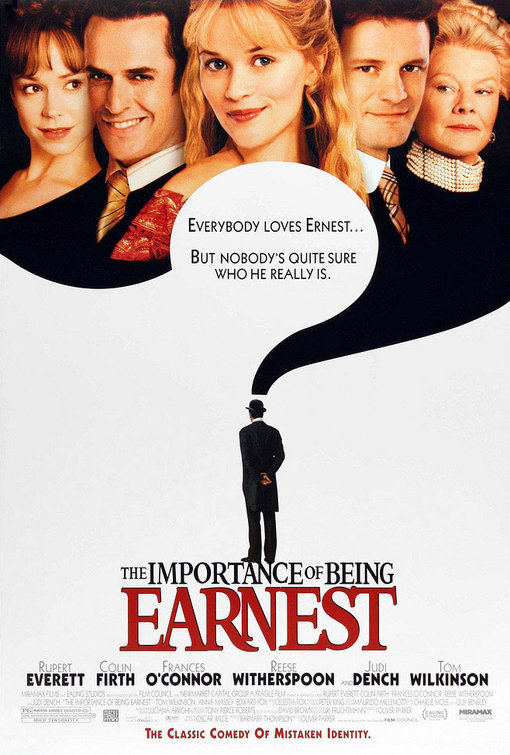
  • I used color coding in my analysis of The Importance of Being Earnest to help readers understand the quotes.
  • I talked about the benefits of social media in my New Social Media post.
  • I searched for a claim for my paper by looking at past blog posts and comments.
  • I got feedback on my thesis statements for my paper.
  • I color coded this post when I analyzed the poem.
  • I also talked to several people on the phone when getting feedback for my paper

The story of my nonsense paper

I got the idea for my paper while thinking about how to decorate my unborn daughter's nursery. That lead to a little research on the classic Winnie-the-Pooh stories which lead to some unpleasant comments on Good Reads that prompted me to defend such a fantastic piece of literature. You can read more on that here.

I started with a few different thesis statements to get the ball rolling. I came up with these after a close reading of Winnie-the-Pooh to determine what all the stories had in common and how I could implement that into a paper. I thought the biggest thing was the grammatical errors. That also seemed to be what people were complaining about in their Good Reads comments.

I got some great feedback on my thesis statements. The comment from my sister even lead me to what I thought would be my thesis. However as I continued to research, I realized there was more to the grammatical errors thing than originally met the eye. A second look at the Good Reads comments introduced me to the genre of Nonsense Literature.

Once I researched the genre a little more, I found that what I thought were grammatical errors were actually forms of implementing nonsense into the story. And from there, my new thesis was born. I was even able to compile all the quotes I thought were grammatical errors but turned out to be related to the genre. It was so helpful to do this, because I could see all the elements of the book I wanted to reference in my paper.

Then before I could begin writing the paper, I had to make an outline! I am HUGE fan of the outline. If I do enough research there, I've done nearly all the work of writing the paper. All I have to do is turn my half baked thoughts into complete sentences and BAM! I'm done. However once I started writing the paper and came up with a rough draft, I realized that my outline was a litte too detailed because I had too much information. It would have been great for a 10 page paper but for my 6 page paper, some stuff had to go.

After some serious re-working which included cutting and combining paragraphs, I came up with my final rough draft. But it was still rough which meant I still had some editing to do. I posted the draft in a google document and was able to edit it with guidance from my mom over the phone. It was cool because she could offer suggestions and then watch me make the changes from her computer in Georgia.

Once I was happy with how it looked, I created an after outline. This gave me a second look at the flow of my paper. It was interesting to see how the before and after outline had changed. Then in class, I classmate peer reviewed my paper and thankfully only had one big thing that confused him that I needed to fix. And what I came up with is a finished product, which I am happy to say is finished several days before it's due.

Now that's one of the best feelings ever!

Wednesday, June 12, 2013

An after outline

I've heard of a lot of revision techniques in my days as a professional student. I personally employ reading out loud, printing it out and reading it with a red pencil to edit as I go, and passing it along to someone else who hasn't written it and can give me a fresh take.

What I hadn't heard of (until my teacher mentioned it) is making another outline after you've written the paper to make sure it flows. What a weird concept. But I think I'll try it.

My paper's structure did change a bit after I wrote and edited it. You can compare it to my first outline here.

Outline:
Introduction
  • Introduce A.A. Milne’s Winnie the Pooh stories
  • Stories for children are generally to teach as they are constantly developing
  • Compare to a story written to teach a lesson- The Story of Snow: The science of Winter’s Wonder by Mark Cassino
  • Thesis: Although many consider nonsense literature to be purely for entertainment purposes, much nonsense literature like A.A. Milne’s Winnie the Pooh stories are actually valuable to learners because they not only help children grasp the concept of language, but they teach them how to sift out the sense from the nonsense.

Final rough draft of Winnie the Pooh paper

Ok folks, I edited my Winnie the Pooh paper so it's the right length, not redundant and it actually makes sense. I ended up cutting entire paragraphs, combining other paragraphs, and editing down others. So much to your excitement (I'm sure) it's 6 pages and not 10.

Here is the link to read the whole paper. Feel free to read it if you want. Or read parts of it. I always love feedback.

If you care to give me some feedback, please look specifically at how well I made my argument, my grammar and tone, and how well the paper flows together.

Let me know what you think with some comment love!!

Monday, June 10, 2013

Genre. I mean Whoa Man!

After discovering that there was a sub genre of fiction called nonsense literature, I'm curious to find other sub genres of fiction that I've never heard of before. Here, I am having grown up reading Dr. Seuss and Alice in Wonderland, and nursery rhymes, never knowing that they were nonsense literature.  And now that I know, I'm much better equipped to understand and analyze them.

I never realized how helpful genre can be in analyzing literature. Once you know the genre and the techniques that, that genre implements it's so much easier to find those techniques and understand why they were used.

So here are some other sub genres of fiction that you might not have heard of before. I chose some books that I'm familiar with to describe them:

Glitz/Glamour romance- a typical romance novel focused on the jet-set elite and celebrity. Think Gossip Girl

Quiet horror- subtly written horror that uses atmosphere and mood to create suspense rather than graphic description. Think Crime and Punishment by Dostoevsky

Technological thriller- in which technology has run amok. Think Digital Fortress by Dan Brown

Bangsian Fantasy- Stories speculating on the after life esp. of celebrities.  Think The Lovely Bones

Cozy mystery/crime- a mystery that takes place in a small town with all suspects present and familiar with one another. Think Lacy Steele mysteries like Morning Cup of Murder.

What I found most amazing about these subgenres that I've never heard of before is that I have read books that fit under each of the categories. Whoa Man! If you want to read about more subgenres, check out this website.

Teaching sense through nonsense with Winnie the Pooh.

Alright folks, I know you've been dying to know what goodies I've come up with in my Winnie the Pooh paper, so here you go. Below is the first paragraph and if you feel so inclined, click the 'read more here' link at the bottom to read the first 5 pages of my paper.

I'd also love your feedback on this. As I got onto the 6th page, I realized that this needs some heavy editing or it's going to be 10 pages long. So keep that in mind as you read it and feel free to suggest where I should cut and rearrange.

Picture this: a round, yellow bear, with Very Little Brains covers himself in mud, to look like a rain cloud of course, and uses a blue balloon, to match the sky of course, to float up to the top of a hunny tree to steal some hunny from the bees. You may recognize this picture from the story, In which we are introduced to Winnie-the-Pooh and Some Bees and the Stories Begin, from the book, Winnie-the-Pooh by A.A. Milne. Children love Winnie the Pooh stories, like the one described above. But most parents and teachers consider stories like Winnie the Pooh only useful for entertainment purposes. Reading for entertainment is a great skill for children to learn early on, because it builds in them the value of learning. Parents and teachers may choose other books for children to enjoy but still teach them something at the same time. For instance, The Story of Snow: The Science of Winter’s Wonder by Mark Cassino. This book is written in the format of a story but is still able to teach children about the world around them, specifically the science of snow. What many parents and teachers don’t realize is that Winnie-the-Pooh has the ability to teach children about the world around them in the same, if not better, way that The Story of Snow does. Winnie-the-Pooh falls under the genre of fiction, but more important to note is it’s sub-genre of nonsense literature. It, and other books of it’s kind have merit for more than their entertainment value. Although many consider nonsense literature to be purely for entertainment purposes, much nonsense literature like A.A. Milne’s Winnie the Pooh stories are actually valuable to learners because they not only help children grasp the concept of language, but they teach them how to sift out the sense from the nonsense.

Read More Here

Just a little outline

I have found that it's nearly impossible for me to write anything without having an outline first. After writing the outline I've done probably half of the work to write the paper. Between the outline and the research and reading beforehand.

So just for fun, I wanted to share my outline for my Winnie the Pooh paper. I like to make it pretty detailed so it's almost like I just need to turn it into full sentences to come up with the paper. It is pretty long, so feel free to just glance if you don't want to read the whole thing.

Outline:
Introduction
  • Introduce A.A. Milne’s Winnie the Pooh stories
  • Stories for children are generally to teach as they are constantly developing
  • Compare to a story written to teach a lesson- The Story of Snow: The science of Winter’s Wonder by Mark Cassino
  • Thesis: Although many consider nonsense literature to be purely for entertainment purposes, much nonsense literature like A.A. Milne’s Winnie the Pooh stories are actually valuable to learners because they not only help children grasp the concept of language, but they teach them how to sift out the sense from the nonsense.

Wednesday, June 5, 2013

This is the why.

I'm actually really enjoying the reading and studying I'm doing for my final paper for my English class. But why in the world did I choose Winnie the Pooh? Random right?

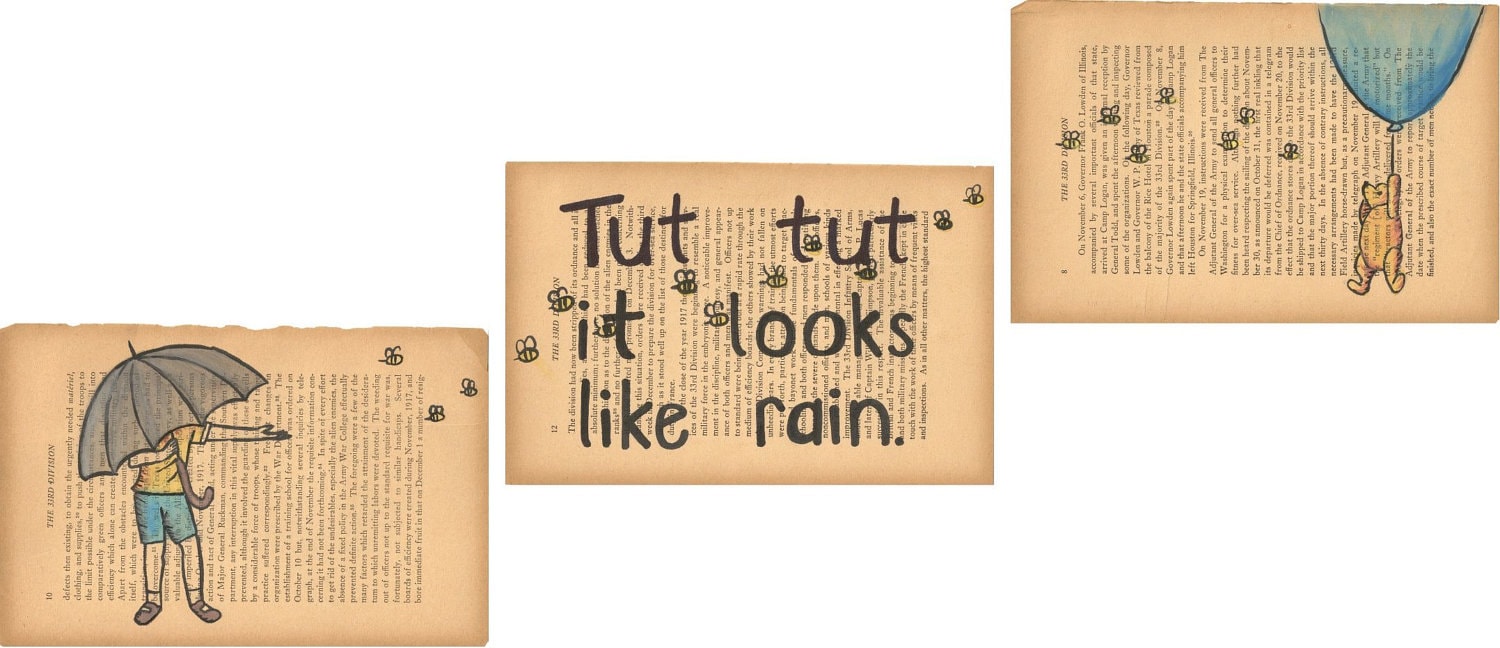
Well it's no secret that I'm expecting a baby in August. Along with all the practical preparation for childbirth comes the preparation of how I'm going to decorate the nursery. Seems a little silly since I live in a tiny two bedroom apartment and the 'nursery' is also the office and craft room. Ha. But it's still fun to think about. I decided that I wanted to do a classic Winnie the Pooh theme based on the story where Pooh pretends to be a black rain cloud to get some honey.

I wanted to frame these and hang them on the wall.

But this still brings up the question, why Winnie the Pooh? I've always loved Winnie the Pooh since I was little. I love the sweet stories of friendship and courage and I think they have a lot to teach children. But all the Pooh stories I've seen and heard have been Disney renditions. It wasn't until I started working on this paper that I realized I haven't actually read the original Pooh stories. In the nursery, the plan was to do it on the original Winnie the Pooh. But how could I do that without having read the stories myself.

In my research, I was amazed by how many people on goodreads had awful things to say about Winnie the Pooh and the author A.A. Milne. In a way, I felt the need to defend the stories that meant so much to me as a child.

So that's the why. That is why I decided to argue that Winnie the Pooh stories are beneficial to teaching young children. Because I plan to read them to my daughter. I want her to love the original stories as well as the Disney renditions. I think she will be able to learn and grow from them and I plan to prove it in my paper.

Does this make sense?

I thought it might be helpful to compile some quotes that seemed to go with my 'nonsense literature' genre in the Winnie the Pooh stories.

(Pink is me, green is quotes from the book)

These are from In Which We Are Introduced to Winnie-the-Pooh and Some Bees, and the Stories Begin from the book, Winnie-The-Pooh.

"You see I meant to do," he explained..."what I meant to do----" "Of course it was rather----" he admitted.... "It all comes, I suppose," he decided..."It all comes of liking honey so much..." (pg 13)

--Pooh's nonsensical ramblings

"I wonder if you've got such a thing as a balloon about you?"
"A balloon?"
"Yes, I just said to myself coming along: 'I wonder if Christopher Robin has such a thing as a balloon about him?' I just said it to myself, thinking of balloons and wondering." (pg 15)

--Redundancy of 'balloon'

"And then, when the balloon was blown up as big as big.." (pg 17)

---as big as big?!

"Christopher--ow---Robin," called out the cloud. (pg 20)

--the cloud talking, who is actually Pooh.

"Well it just happened that you had been to a party the day before a the house of your friend Piglet, and you had balloons at the party." (pg. 16)

---the use of 'you' as the narrator is telling the story, implying that he's telling it to Christopher Robin.

These are from In Which A House Is Built at Pooh Corner for Eeyore from the book, The House at Pooh Corner

"Christopher Robin had spent the morning indoors going to Africa and back, and he had just got off the boat and was sondering what it was like outside..." (pg 18)

--- How could he have been travelling to Africa and back indoors?!

"It isn't Close, if you know what I mean..."
"It isn't Stuffy."
"quite-between-ourselves- and-don't-tell-anybody, it's Cold"
"They haven't got Brains, any of them..."
"..so very much too Hot..."
"And then it will Get About and they'll be Sorry." (pg 20)

---Capitalization of random words that don't have any sort of pattern

"They haven't got Brains, any of them, only grey fluff that's blown into their heads by mistake..." (pg 20)

---Eeyore is saying this but he is also a stuffed animal, but if they were stuffed animals than the fluff would be there on purpose not by mistake...nonsense.

So those were just a few of the quotes I've compiled. But I think they'll help me make my point in my paper!


Tuesday, June 4, 2013

Nonsense literature- finding a genre

Despite this past weekend's attempt at getting help for a thesis statement, when I sat down to begin drafting I found that I still didn't feel like this was quite as developed as I wanted it to be.


"Unlike some children's books that are written specifically to teach, A.A. Milne's Winnie the Pooh stories are valuable to learners not because of their pristine grammar but because they encourage imagination and thus further cognitive development."

Above is the thesis I had decided on. But in order to find more clarity I took to Goodreads to see what others were saying about Winnie the Pooh.

Pushed


The most recent book I've been reading (besides Winnie the Pooh for my final paper) is another one that falls under the nonfiction category. I still have a hard time believing how many things I read that are nonfiction. I'm not entirely sure what subcategory of nonfiction this would fit under.

It's a pretty educational book that implements research and stories to explain the state of modern childbirth and maternity care in the U.S. Would that be educational? Is that a subcategory of nonfiction?

Monday, June 3, 2013

Thanks for the feedback!

So after getting some help from my lovely blog readers and other friends on facebook and by other archaic means like the phone, I think I've come up with my thesis for my paper for my English class.

But before that, I thought I'd share how this whole feedback process went.

I posted a blog post with all my thesis statements and then posted a link to it on facebook and asked my friends to offer their opinions.


And wouldn't you know it, a couple of my friends did comment on the blog. And then I got a few more comments from people in my English class. All of which were extremely helpful.


After reading through these and talking to my mom (always a good source for opinions) I decided to stick with the thesis that my sister wrote (Jessica above).


Unlike some children's books that are written specifically to teach, A.A. Milne's Winnie the Pooh stories are valuable to learners not because of their pristine grammar but because they encourage imagination and thus further cognitive development.

There seemed to be some consensus on moving away from the grammatical incorrectness (not a word) theme and sticking more to comparing Winnie the Pooh to books that are meant to specifically teach children.

Friday, May 31, 2013

Winnie the Pooh in 5 thesis statements

Alright folks, I'll keep this short and to the point. I'm writing an English paper and I would LOVE some feedback on which of these thesis statements seems to work out best.

You could also tell me that none of them work but I'd really appreciate a why so I can figure out what to do to fix them. Also if you think I need to rethink my whole paper premise, that opinion would also be greatly appreciated if expounded upon.

I wrote 5 different types of statements.

Wednesday, May 29, 2013

In search of a claim

In an attempt to figure out what interests me as far as topics to discuss in a paper, I have been reviewing some of my previous work. This has not been an easy task. It appears as though my interests are sort of across the board.

So to categorize, I used the criteria outlined by my English professor in his post here.

Behold, this new and social media

And behold, I say unto you my brethren, how else may a student studying at a university that is choice above all other universities but even still situated across many lands from his family effectively converse  with them if not by new and social media?

Behold I say unto you, nay. A man hath no form of communication and connection to the will of his heart with distant family were it not for facebook, youtube, instagram and blogger.

The Red Dirt Bride

I am truly amazed at how many subgenres there are in nonfiction. So many that I didn't realize a lot of what I enjoy reading is nonfiction. It usually falls under the ever expanding category of blog posts. Especially as a soon-to-be mom, I love me some mommy blogs!

But what I also didn't realize is that I write nonfiction for a living. How did I not know that, right?

Let me explain. I am a freelance writer for a blog called, The Red Dirt Bride. I write two types of posts. One type is advice in a series called Between the Rings which is everything a bride needs to know to plan her wedding from engagement to "I Do." I'm not entirely sure how to categorize the second type. It's a mix of sort of biography, journalism, and just plain old blog post. These posts are called Real Weddings. I get photo submissions from wedding photographers and then write a post about the wedding based on the photos. (Click on the Real Weddings link above to see what I mean.)

Saturday, May 25, 2013

It Runs in the Family


Yeah that's me, in a fat suit sitting down on the left.
After acting out the same brief scene from Death of a Salesman in our English class on Thursday, we got to talking about how you have to immerse yourself in a role and really become that character you're trying to portray. This can have positive effects on you and help you learn more about yourself. Or it can have negative effects on you depending on the type of character you have to portray.

Acting is such an interesting thing because you get to be someone else and that's a lot of fun. You get to step outside of any problems, stresses, or anxieties in your life and become someone who is the epitome of not you. It's fun to not care what people think of you on stage because you aren't you.

I've been in a lot of plays and musicals but by far my favorite was in high school when I played Matron in It Runs in the Family. I got to be the complete and total opposite of myself. I wore a fat suit for goodness sakes! I talked with a fake cigarette in my mouth and modeled my voice and attitude after Roz, the slug in Monster's Inc. It was the most fun I've ever had in theater. I had to learn how an overweight person acts physically (slower movements). I had to channel something that I would never be and I loved it. The best part was that after one of our shows, I tried to talk to a friend of mine who had just seen the show and she didn't recognize that I was me.
If you ever get the chance to see It Runs in the Family, I highly recommend it! It's a classic comedy of errors. The characteristics of which are a series of mistaken identity and in this play it's in a hospital no less. Just imagine: the wrong people getting shots and going loopy and of course you have your old man whose mind is going and add a long lost son to that. It's hilarious!

The truth is rarely pure and never simple part 2

So in part one of this post it wasn't until the end of the post that I realized how true the title of the post was. I randomly chose the title from a quote from the play, The Importance of Being Ernest by Oscar Wilde, that I really liked.

But when you pull that quote out of the play itself and compare it to the play as a whole, it almost makes a better title than The Importance of Being Ernest (almost).

For those of you who haven't read the whole play or ever seen the movie, here is a brief summary. But SPOILER ALERT, just in case you want to be surprised if you plan on reading/watching it.

I man named Jack lives in the country and under the guise of visiting his useless brother, Ernest, he visits the city. Ernest doesn't actually exist but to keep up the rouse, Jack tells his friends in the city that his name is Ernest. Under this rouse he meets a woman, Gwendolyn, and falls in love with her and proposes, but she thinks his name is Ernest and shows much pride in the name and even says she wouldn't marry anyone else. However, since Jack was an orphan, Gwendolyn's mother refuses to approve of the marriage.

Thursday, May 23, 2013

The truth is rarely pure and never simple


In my personal learning plan, I had planned on reading The Importance of Being Earnest. I really like other things I've read by Oscar Wilde and I've seen the movie so it seemed like the next step would be to read the actual play. The assignment in my English class to read the first scene gave me the motivation I needed to just go ahead and read the rest of the play.

Unfortunately between my other class and work and well, having a life, I haven't had time to finish the whole play yet (in the one day we had between the assignment and today), but I do plan to finish it this weekend.

Once I finish reading the play, I plan on re-watching the movie to compare it. Obviously it would be ideal to watch the play itself, but it will be equally as interesting to compare the movie adaption and see how closely they kept to the play.

I'm loving the play so far. Oscar Wilde is so clever and I am continually underlining quotes from the script that are just hilarious!

The one character so far that I'm really looking forward to analyzing a little more is Lane and his relationship with Algernon. In the rendition I'm reading a footnote stated that Lane's sarcasm shows that his relationship with Algernon is very complex. I found this intriguing.

I think that often, supporting characters like Lane can have a significant impact on the story. I guess we'll see as I read further and re-watch the movie.

Have any of you compared the play the Importance of Being Earnest to the movie? Or any other plays to the movie for that matter?

**On a side note, knowing the story of The Importance of Being Earnest, I think the quote I chose for the title of this post from act one is particularly telling, don't you?**

Tuesday, May 21, 2013

I think Oedipus Rex would be boring to watch.

Woah! What? How dare I say something so bold about such a great work of drama. Give me a second of your time and I'll clarify this.


For those of you readers who have been living under a rock, Oedipus is a story about a king who is told his son will murder him and marry the queen. So he tries to have his son killed but a kind servant spares him and the son grows up and well wouldn't you know it, he ends up killing his father and marrying his mother. This son is Oedipus Rex.

"Wow, that sounds like a super interesting story. Why would you think the play would be boring?"