I got the idea for my paper while thinking about how to decorate my unborn daughter's nursery. That lead to a little research on the classic Winnie-the-Pooh stories which lead to some unpleasant comments on Good Reads that prompted me to defend such a fantastic piece of literature. You can read more on that here.
I started with a few different thesis statements to get the ball rolling. I came up with these after a close reading of Winnie-the-Pooh to determine what all the stories had in common and how I could implement that into a paper. I thought the biggest thing was the grammatical errors. That also seemed to be what people were complaining about in their Good Reads comments.
I got some great feedback on my thesis statements. The comment from my sister even lead me to what I thought would be my thesis. However as I continued to research, I realized there was more to the grammatical errors thing than originally met the eye. A second look at the Good Reads comments introduced me to the genre of Nonsense Literature.
Once I researched the genre a little more, I found that what I thought were grammatical errors were actually forms of implementing nonsense into the story. And from there, my new thesis was born. I was even able to compile all the quotes I thought were grammatical errors but turned out to be related to the genre. It was so helpful to do this, because I could see all the elements of the book I wanted to reference in my paper.
Then before I could begin writing the paper, I had to make an outline! I am HUGE fan of the outline. If I do enough research there, I've done nearly all the work of writing the paper. All I have to do is turn my half baked thoughts into complete sentences and BAM! I'm done. However once I started writing the paper and came up with a rough draft, I realized that my outline was a litte too detailed because I had too much information. It would have been great for a 10 page paper but for my 6 page paper, some stuff had to go.
After some serious re-working which included cutting and combining paragraphs, I came up with my final rough draft. But it was still rough which meant I still had some editing to do. I posted the draft in a google document and was able to edit it with guidance from my mom over the phone. It was cool because she could offer suggestions and then watch me make the changes from her computer in Georgia.
Once I was happy with how it looked, I created an after outline. This gave me a second look at the flow of my paper. It was interesting to see how the before and after outline had changed. Then in class, I classmate peer reviewed my paper and thankfully only had one big thing that confused him that I needed to fix. And what I came up with is a finished product, which I am happy to say is finished several days before it's due.
Now that's one of the best feelings ever!
Showing posts with label Winnie the Pooh. Show all posts
Showing posts with label Winnie the Pooh. Show all posts
Friday, June 14, 2013

Wednesday, June 12, 2013
An after outline
I've heard of a lot of revision techniques in my days as a professional student. I personally employ reading out loud, printing it out and reading it with a red pencil to edit as I go, and passing it along to someone else who hasn't written it and can give me a fresh take.
What I hadn't heard of (until my teacher mentioned it) is making another outline after you've written the paper to make sure it flows. What a weird concept. But I think I'll try it.
My paper's structure did change a bit after I wrote and edited it. You can compare it to my first outline here.
What I hadn't heard of (until my teacher mentioned it) is making another outline after you've written the paper to make sure it flows. What a weird concept. But I think I'll try it.
My paper's structure did change a bit after I wrote and edited it. You can compare it to my first outline here.
Outline:
Introduction
- Introduce A.A. Milne’s Winnie the Pooh stories
- Stories for children are generally to teach as they are constantly developing
- Compare to a story written to teach a lesson- The Story of Snow: The science of Winter’s Wonder by Mark Cassino
- Thesis: Although many consider nonsense literature to be purely for entertainment purposes, much nonsense literature like A.A. Milne’s Winnie the Pooh stories are actually valuable to learners because they not only help children grasp the concept of language, but they teach them how to sift out the sense from the nonsense.
Final rough draft of Winnie the Pooh paper
Ok folks, I edited my Winnie the Pooh paper so it's the right length, not redundant and it actually makes sense. I ended up cutting entire paragraphs, combining other paragraphs, and editing down others. So much to your excitement (I'm sure) it's 6 pages and not 10.
Here is the link to read the whole paper. Feel free to read it if you want. Or read parts of it. I always love feedback.
If you care to give me some feedback, please look specifically at how well I made my argument, my grammar and tone, and how well the paper flows together.
Let me know what you think with some comment love!!
Monday, June 10, 2013
Teaching sense through nonsense with Winnie the Pooh.
Alright folks, I know you've been dying to know what goodies I've come up with in my Winnie the Pooh paper, so here you go. Below is the first paragraph and if you feel so inclined, click the 'read more here' link at the bottom to read the first 5 pages of my paper.
I'd also love your feedback on this. As I got onto the 6th page, I realized that this needs some heavy editing or it's going to be 10 pages long. So keep that in mind as you read it and feel free to suggest where I should cut and rearrange.
Picture this: a round, yellow bear, with Very Little Brains covers himself in mud, to look like a rain cloud of course, and uses a blue balloon, to match the sky of course, to float up to the top of a hunny tree to steal some hunny from the bees. You may recognize this picture from the story, In which we are introduced to Winnie-the-Pooh and Some Bees and the Stories Begin, from the book, Winnie-the-Pooh by A.A. Milne. Children love Winnie the Pooh stories, like the one described above. But most parents and teachers consider stories like Winnie the Pooh only useful for entertainment purposes. Reading for entertainment is a great skill for children to learn early on, because it builds in them the value of learning. Parents and teachers may choose other books for children to enjoy but still teach them something at the same time. For instance, The Story of Snow: The Science of Winter’s Wonder by Mark Cassino. This book is written in the format of a story but is still able to teach children about the world around them, specifically the science of snow. What many parents and teachers don’t realize is that Winnie-the-Pooh has the ability to teach children about the world around them in the same, if not better, way that The Story of Snow does. Winnie-the-Pooh falls under the genre of fiction, but more important to note is it’s sub-genre of nonsense literature. It, and other books of it’s kind have merit for more than their entertainment value. Although many consider nonsense literature to be purely for entertainment purposes, much nonsense literature like A.A. Milne’s Winnie the Pooh stories are actually valuable to learners because they not only help children grasp the concept of language, but they teach them how to sift out the sense from the nonsense.
Read More Here
Wednesday, June 5, 2013
This is the why.
I'm actually really enjoying the reading and studying I'm doing for my final paper for my English class. But why in the world did I choose Winnie the Pooh? Random right?
Well it's no secret that I'm expecting a baby in August. Along with all the practical preparation for childbirth comes the preparation of how I'm going to decorate the nursery. Seems a little silly since I live in a tiny two bedroom apartment and the 'nursery' is also the office and craft room. Ha. But it's still fun to think about. I decided that I wanted to do a classic Winnie the Pooh theme based on the story where Pooh pretends to be a black rain cloud to get some honey.
But this still brings up the question, why Winnie the Pooh? I've always loved Winnie the Pooh since I was little. I love the sweet stories of friendship and courage and I think they have a lot to teach children. But all the Pooh stories I've seen and heard have been Disney renditions. It wasn't until I started working on this paper that I realized I haven't actually read the original Pooh stories. In the nursery, the plan was to do it on the original Winnie the Pooh. But how could I do that without having read the stories myself.
In my research, I was amazed by how many people on goodreads had awful things to say about Winnie the Pooh and the author A.A. Milne. In a way, I felt the need to defend the stories that meant so much to me as a child.
So that's the why. That is why I decided to argue that Winnie the Pooh stories are beneficial to teaching young children. Because I plan to read them to my daughter. I want her to love the original stories as well as the Disney renditions. I think she will be able to learn and grow from them and I plan to prove it in my paper.
Well it's no secret that I'm expecting a baby in August. Along with all the practical preparation for childbirth comes the preparation of how I'm going to decorate the nursery. Seems a little silly since I live in a tiny two bedroom apartment and the 'nursery' is also the office and craft room. Ha. But it's still fun to think about. I decided that I wanted to do a classic Winnie the Pooh theme based on the story where Pooh pretends to be a black rain cloud to get some honey.
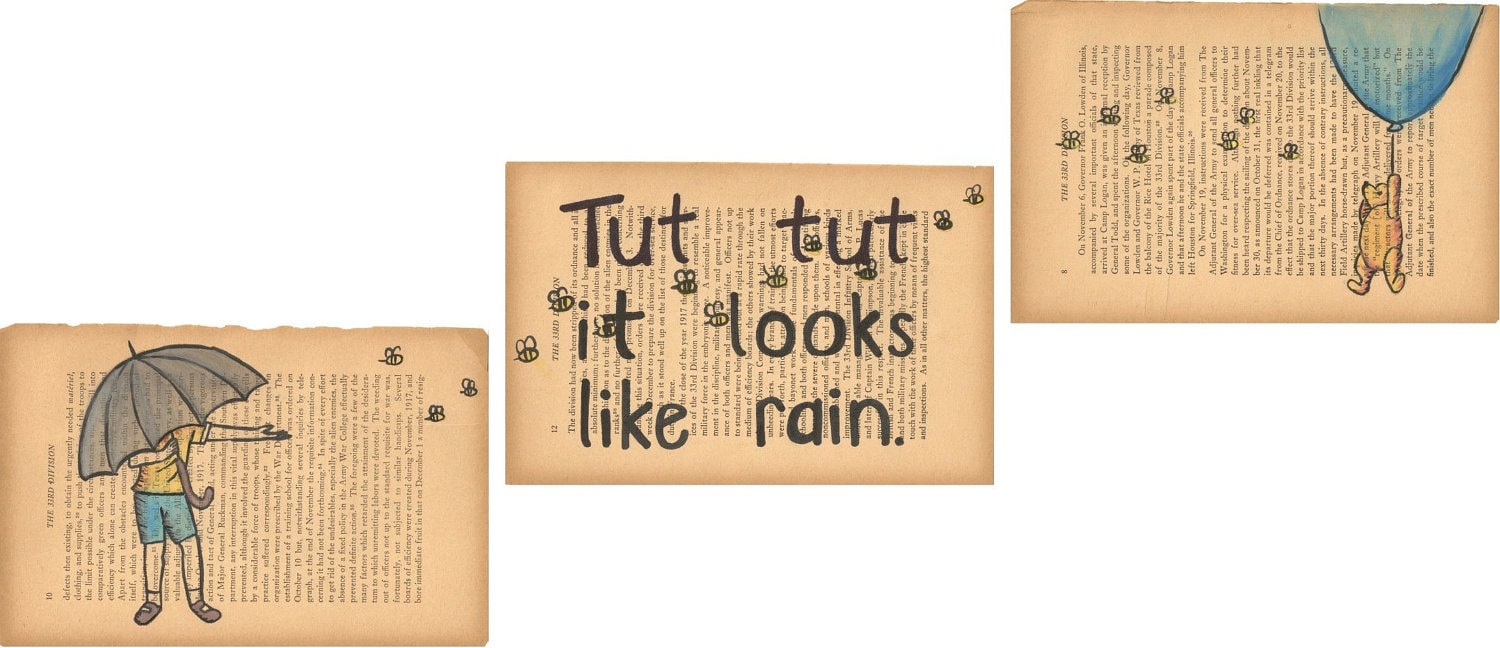 |
| I wanted to frame these and hang them on the wall. |
In my research, I was amazed by how many people on goodreads had awful things to say about Winnie the Pooh and the author A.A. Milne. In a way, I felt the need to defend the stories that meant so much to me as a child.
So that's the why. That is why I decided to argue that Winnie the Pooh stories are beneficial to teaching young children. Because I plan to read them to my daughter. I want her to love the original stories as well as the Disney renditions. I think she will be able to learn and grow from them and I plan to prove it in my paper.
Does this make sense?
I thought it might be helpful to compile some quotes that seemed to go with my 'nonsense literature' genre in the Winnie the Pooh stories.
(Pink is me, green is quotes from the book)
These are from In Which We Are Introduced to Winnie-the-Pooh and Some Bees, and the Stories Begin from the book, Winnie-The-Pooh.
"You see I meant to do," he explained..."what I meant to do----" "Of course it was rather----" he admitted.... "It all comes, I suppose," he decided..."It all comes of liking honey so much..." (pg 13)
--Pooh's nonsensical ramblings
"I wonder if you've got such a thing as a balloon about you?"
"A balloon?"
"Yes, I just said to myself coming along: 'I wonder if Christopher Robin has such a thing as a balloon about him?' I just said it to myself, thinking of balloons and wondering." (pg 15)
--Redundancy of 'balloon'
"And then, when the balloon was blown up as big as big.." (pg 17)
---as big as big?!
"Christopher--ow---Robin," called out the cloud. (pg 20)
--the cloud talking, who is actually Pooh.
"Well it just happened that you had been to a party the day before a the house of your friend Piglet, and you had balloons at the party." (pg. 16)
---the use of 'you' as the narrator is telling the story, implying that he's telling it to Christopher Robin.
These are from In Which A House Is Built at Pooh Corner for Eeyore from the book, The House at Pooh Corner
"Christopher Robin had spent the morning indoors going to Africa and back, and he had just got off the boat and was sondering what it was like outside..." (pg 18)
--- How could he have been travelling to Africa and back indoors?!
"It isn't Close, if you know what I mean..."
"It isn't Stuffy."
"quite-between-ourselves- and-don't-tell-anybody, it's Cold"
"They haven't got Brains, any of them..."
"..so very much too Hot..."
"And then it will Get About and they'll be Sorry." (pg 20)
---Capitalization of random words that don't have any sort of pattern
"They haven't got Brains, any of them, only grey fluff that's blown into their heads by mistake..." (pg 20)
---Eeyore is saying this but he is also a stuffed animal, but if they were stuffed animals than the fluff would be there on purpose not by mistake...nonsense.
So those were just a few of the quotes I've compiled. But I think they'll help me make my point in my paper!
Tuesday, June 4, 2013
Nonsense literature- finding a genre
Despite this past weekend's attempt at getting help for a thesis statement, when I sat down to begin drafting I found that I still didn't feel like this was quite as developed as I wanted it to be.

"Unlike some children's books that are written specifically to teach, A.A. Milne's Winnie the Pooh stories are valuable to learners not because of their pristine grammar but because they encourage imagination and thus further cognitive development."
Above is the thesis I had decided on. But in order to find more clarity I took to Goodreads to see what others were saying about Winnie the Pooh.
Friday, May 31, 2013
Winnie the Pooh in 5 thesis statements
Alright folks, I'll keep this short and to the point. I'm writing an English paper and I would LOVE some feedback on which of these thesis statements seems to work out best.
You could also tell me that none of them work but I'd really appreciate a why so I can figure out what to do to fix them. Also if you think I need to rethink my whole paper premise, that opinion would also be greatly appreciated if expounded upon.
I wrote 5 different types of statements.
You could also tell me that none of them work but I'd really appreciate a why so I can figure out what to do to fix them. Also if you think I need to rethink my whole paper premise, that opinion would also be greatly appreciated if expounded upon.
I wrote 5 different types of statements.
Subscribe to:
Posts (Atom)